Basket
0
There Are More Living Things in a Handful of Soil Than People on Earth
Focus keyword: what lives in soil Meta description: Soil isn't just dirt. A single handful contains billions of living organisms. Here's who they are, what they do, and why it matters for your compost.
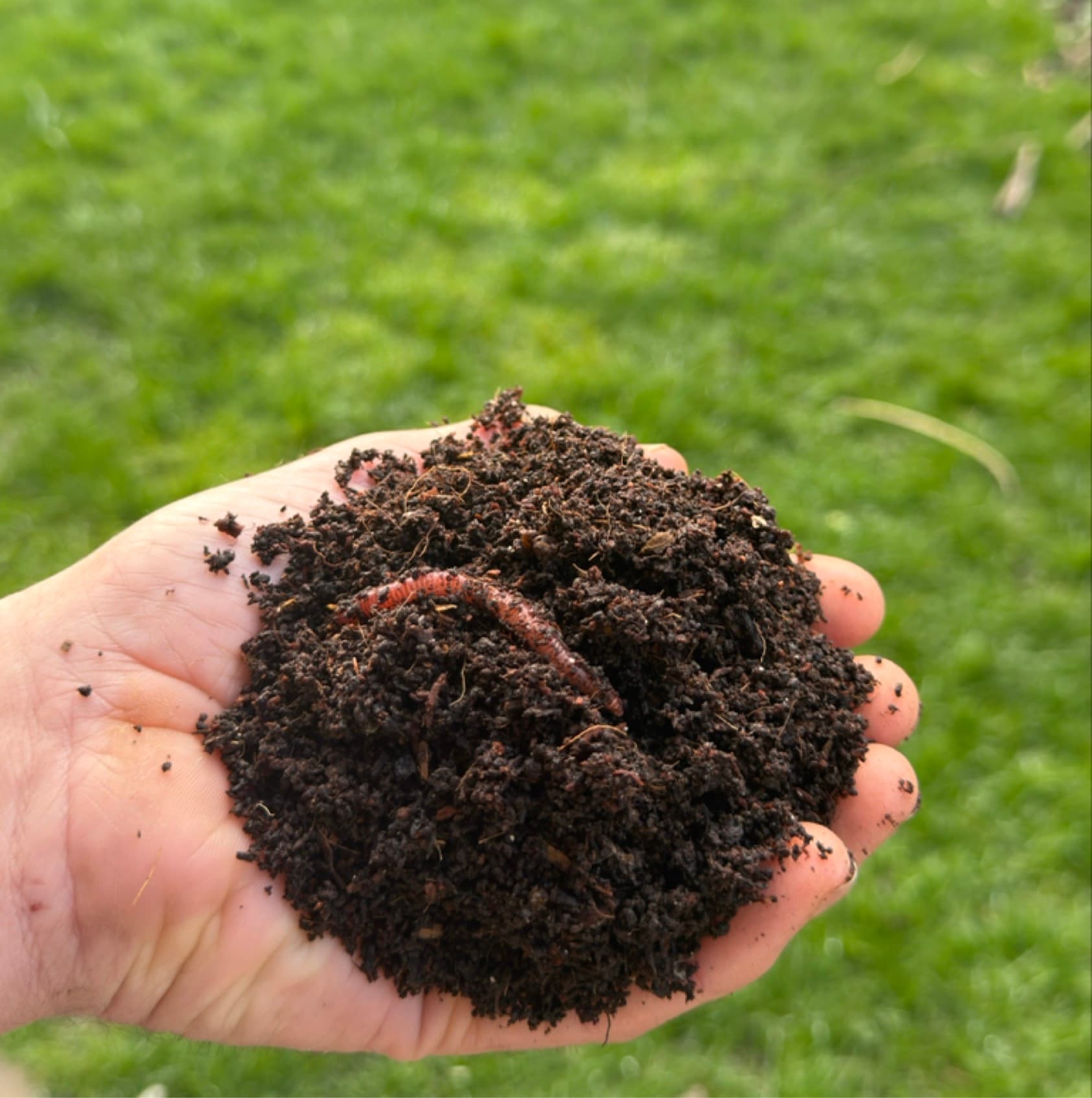
Pick up a handful of soil. Really think about what you're holding.
Not dirt. Not dead ground. A city. A living, breathing, eating, reproducing city of organisms so dense and so varied that scientists reckon healthy, nutrient-rich soil can harbour more individual creatures than there are people on this planet. In one gram. One gram of soil.
That's the thing about the world beneath our feet. It's not empty. It's not static. It's teeming, processing, converting, communicating. And for anyone who keeps a worm bin, runs a compost heap, or grows anything in a pot on a balcony, understanding what's down there changes everything about how you think about feeding your plants and managing your soil.
So who exactly is living in there?
The Four Tiers of Soil Life
Scientists classify soil organisms by size, which turns out to be a surprisingly useful way to understand what they actually do.
At the smallest end, you've got the microorganisms. Bacteria, fungi, protozoa, algae. Invisible to the naked eye, incomprehensible in number. A single teaspoon of healthy soil can contain around a billion bacteria, representing thousands of different species. These are the chemical engineers of the soil world. They break things down. They fix nitrogen from the air. They dissolve minerals that plants couldn't otherwise access. Without them, nothing else works.
Then come the mesofauna — organisms between roughly 0.2 and 2 millimetres: springtails, mites, nematodes, tiny beetles. You'd need a magnifying glass to see most of them. They feed on bacteria and fungi, on decaying plant matter, and on each other. They're the biological regulators, keeping microbial populations in check, moving nutrients around, and creating the conditions that allow microbes to thrive.
Springtails are a good example of how strange and specific soil life gets. Collembola, to use their proper name, feed primarily on fungi, grazing the fungal threads running through your compost the way a cow grazes a field. Their defining feature is the furca, a tiny forked appendage tucked under the abdomen that acts like a spring, catapulting them into the air when threatened. It's one of the more extraordinary bits of engineering in the animal kingdom, built into something you could lose on a fingertip. What's even more interesting is that some species have lost the ability to use it entirely. Living deep in dense leaf litter or enclosed spaces where jumping is useless, they've evolved past it. The environment shaped the organism.
Above that, the macrofauna. Earthworms, centipedes, beetle larvae, ants, woodlice. Here is where things get visible. These are the ecosystem engineers, physically reshaping the soil through tunnelling, mixing, and digesting. An earthworm doesn't just pass through the soil. It transforms it.
And then, at the top, megafauna — moles, voles, shrews, even rats. Often overlooked in the compost conversation, but they burrow, aerate, and redistribute organic matter across whole ecosystems. Making them especially annoying in a garden compost set-up
Every single tier matters. Pull one out, and the others feel it.
Why "Just Dirt" Is the Most Expensive Mistake a Gardener Makes
Here's what most people never consider when they reach for a bag of synthetic fertiliser or a bottle of pesticide. The soil isn't a passive growing medium. It's an active, self-regulating system. Every input you add either supports that system or disrupts it.
Before we get into why, let's sit with a few numbers from the Soil Association that put the stakes in perspective.
95% of food production on Earth relies on soil. Soils store more carbon than the atmosphere and all the world's plants and forests combined — the UK's soil alone holds close to 10 billion tonnes of it. Healthy soil can store the equivalent of one and a half Olympic swimming pools of water per hectare, and in total, the UK's soils hold more water than all our lakes and rivers put together. And we're losing topsoil somewhere between 10 and 40 times faster than it forms. Every minute, around 30 football pitches of fertile soil are gone.
That's not a gardening problem. That's a civilisation problem.
The ecosystem beneath your feet is effectively an information network. Nutrients flow in, get processed, feed organisms, which feed other organisms, which die, decompose, and return to the system as fresh inputs. Feedback loops operate continuously. Soil scientists call this ecosystem cybernetics, which sounds complicated, but it just means the soil regulates itself. Given the right conditions, it knows what to do.
The moment you pour a heavy dose of synthetic nitrogen onto that system, or drench it with a broad-spectrum pesticide, you're not just adding or removing one thing. You're sending a signal through the whole network. Microbial communities shift. Populations that were balanced become unbalanced. The feedback loops that kept things stable start to wobble.
This is why plots that are farmed with heavy chemical inputs for decades often look fine on the surface but have soil with the biological diversity of a car park. The plants are being kept alive artificially, the way you'd keep someone on a drip. The underlying life that would have supported them naturally has been quietly hollowing out.
Your Worm Bin Is a Soil Ecosystem in Miniature
If you run a worm bin, you're already managing a soil ecosystem. Maybe you didn't think of it that way. But the dynamics are the same.
Your Dendrobaena worms are the macrofauna, the ecosystem engineers. They're shredding organic material, moving through it, casting it. But they are not working alone. Around them, in the bedding, in the food scraps, in the moisture and air pockets of your bin, bacteria are breaking down the material before the worms even reach it. Fungi are threading through decomposing matter, unlocking nutrients. Mites and springtails regulate microbial populations. There are nematodes doing things at a scale too small to see.
A healthy worm bin has all of this going on simultaneously. The worms are the headline act, yes. But the supporting cast is doing enormous amounts of invisible work.
When your bin smells bad, or your worms are trying to escape, or your castings look off, there's a good chance the issue isn't really about the worms. It's about the ecosystem around them. Something in the balance has shifted. And getting it right again means understanding the biology, not just poking the worms.
Soil Is the Most Biodiverse Habitat on Earth
Let that sit for a moment.
A 2023 study published in the Proceedings of the National Academy of Sciences by Anthony, Bender, and van der Heijden reviewed the global biodiversity literature. It concluded that soil is home to around 59% of all species on Earth. Not a quarter. More than half. More than the oceans, more than rainforests, more than any other single habitat. And the vast majority of those species haven't even been named yet.
And yet we compact it, pour concrete over it, saturate it with chemicals, and strip it of organic matter, and mostly think nothing of it.
The good news for anyone who composts or runs a worm bin is that you're already on the right side of this. Every time you return organic matter to the soil, you're feeding that ecosystem. You're giving the bacteria something to process, the fungi something to feed on, and the mites, springtails, and nematodes something to eat and somewhere to live.
It's the most fundamental thing you can do for your garden, your plants, your growing space. Not because it's trendy, or because someone on social media told you to. Because the science is clear. Life in the soil creates the conditions for life above it.
Coming Next
In the next post in this series, we're going into the bacterial world specifically—nitrogen-fixing bacteria, phosphate-solubilisers, and decomposers. The invisible chemistry happening in your compost bin right now, and what you can do to encourage it.
Wormi Vermi supplies live Dendrobaena worms for composting, delivered across the UK. If you're building or maintaining a worm bin, here is a good place to start.