Cart
0
You may also like


I spend a lot of time watching worms. Probably more than most people would consider normal. But when you're farming worms and composting day in, day out, you start noticing things. Asking questions. And eventually, you stop guessing and just run the experiment yourself.
This one started with a broccoli stalk. And if you want a proper stress test of what worms can and can't handle, broccoli is about as good as it gets. Dense, waxy, almost offensively resilient, it can stay in a compost pile for months. If you've ever thrown a broccoli stalk into a compost heap and come back three weeks later to find it's started regrowing, you'll know exactly what I mean. The thing practically refuses to die.
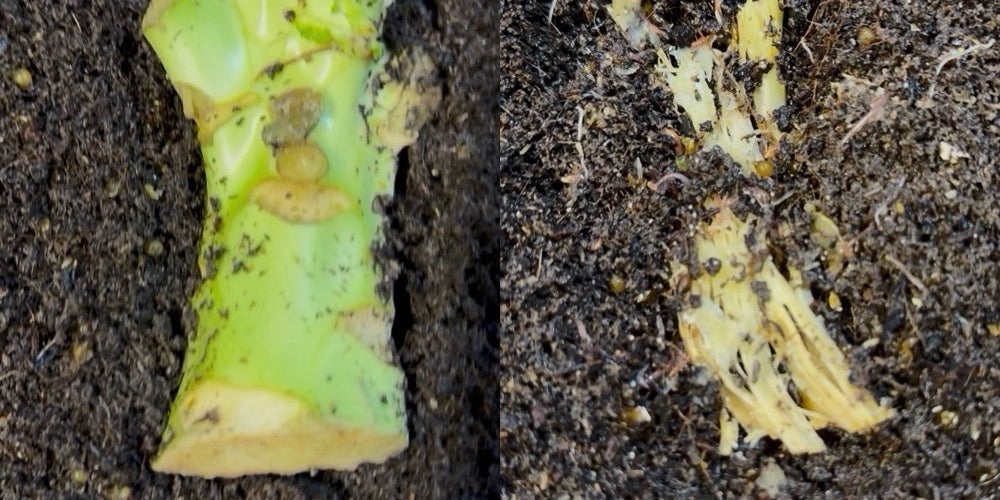
So, on one particular day, I was getting rid of the broccoli stalk, and I just thought I would try an experiment. So I sliced it down the middle, so I had 2 equal halves. Both halves went into the tub at the same time. One is completely fresh. The other had been in the freezer overnight and thawed that morning. Same tub, same worms, same conditions. The only variable was what happened to one piece before it went in.
I wasn't expecting what happened next. Well, i wasnt expecting the difference to be so drastic.
For the first couple of days, not much from either piece. Typical worm behaviour. They're cautious, they explore, they take their time.
But what I noticed first was a change in texture on the frozen half. Before any worm had really committed to it, it was already softening. Going rubbery. That dense, waxy structure is beginning to give way. And then, once it reached that point, the worms found it.
A cluster gathered underneath the frozen half. Not all of them, just a small minorityl at first. But they were clearly on it. Working it. The fresh half? Still sitting there, completely untouched, looking smug.
Then, as the week went on, more worms joined the cluster. Then more still. Like, word was somehow getting around. And that got me thinking about something I'll come back to in a moment.
By the end of the first week, the frozen half was almost completely gone. Just a bit of fibre left, the structural stuff that always takes longer. The fresh half was still sitting there. Almost completely intact.

That was a month ago. The fresh broccoli is still in the tub. Still there. Still barely broken down.

One stalk, one freezer, one night. The difference was extraordinary.
Here is the bit I find genuinely fascinating. When you freeze plant matter, the water inside each cell expands and physically ruptures the cell walls. By the time it thaws, the tissue has already been broken down at the microscopic level. Softer, wetter, far easier to access. The worms do not have to sit around waiting for bacteria to do that work first. The freezer already did it for them.
Broccoli stalk is a perfect test subject for exactly this reason. Fresh, it is basically a fortress. Dense cells, tough skin, tightly packed structure. Worms struggle with it. Frozen and thawed, it is already half dismantled before a single worm arrives. The cell walls are gone. The moisture is released. It is, in worm terms, a completely different food.
Which is why the unfrozen half is still sitting in my tub four weeks later, looking wethered but largely intact.
This is the question that has stayed with me since I ran this experiment. The worms did not all move to the frozen half at once. It started with a few, then more arrived over the following days. Gradual. Incremental. Like word was actually getting around somehow.
Think about that for a second. They are blind. No light detection, no sound. So what is the signal? What are they following?
I have a theory. But I would rather test it properly than just assert something and call it a day. So that is the next experiment. A simple maze, a food source at one end, worms at the other. Can they actively navigate towards it? Or is the movement more random than it appears? I will document the whole thing. Watch this space.
If you are keeping axolotls and farming your own feeder worms at home, or even just buying worms and keeping them in a tub between deliveries, this is genuinely worth knowing.
Freezing your worm food before you add it is not just a useful way to use up scraps. It actively speeds up consumption. Which means faster gut-loading, less uneaten food rotting in the tub, and healthier, better-nourished worms going into your tank. For axolotl keepers especially, that last part matters. A well-fed, healthy worm is a more nutritious meal than one that has been slowly starving in a tub of untouched broccoli for a fortnight.
Dense vegetables in particular. Broccoli, carrot, courgette. The stuff that would normally sit untouched for days. Freeze it overnight, thaw it, drop it in. The difference is significant.
I did not expect one broccoli stalk cut in half to teach me as much as it did. But that is the thing about actually testing instead of just assuming. You find out what is real.
More experiments coming. If there is something you have been wondering about worm behaviour or feeding, drop it in the comments, and I might just run it for you.